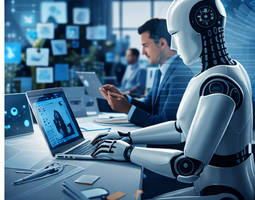
Artificial Intelligence in 2026: How AI Is Transforming Everyday Life and Business
Artificial Intelligence (AI) is no longer a futuristic concept limited to science fiction or research labs. In 2026, AI has become a core part of our daily lives, influencing how we work, communicate, shop, and make decisions. From smart assistants and personalized recommendations to advanced business automation, AI is reshaping industries at an unprecedented pace.
This article explores what artificial intelligence really is, how it is being used today, its benefits and challenges, and what the future holds for individuals and businesses.
What Is Artificial Intelligence?
Artificial Intelligence refers to computer systems designed to perform tasks that typically require human intelligence. These tasks include learning, problem-solving, decision-making, speech recognition, image analysis, and language understanding.
Modern AI systems rely heavily on:
-
Machine Learning (ML) – Algorithms that learn from data
-
Deep Learning – Neural networks inspired by the human brain
-
Natural Language Processing (NLP) – Understanding and generating human language
-
Computer Vision – Interpreting images and videos
Unlike traditional software, AI systems improve over time as they process more data.
How AI Is Used in Everyday Life
Many people use AI daily without realizing it. Here are some of the most common examples:
1. Smart Assistants
Virtual assistants like voice-activated apps can set reminders, answer questions, control smart home devices, and even manage schedules.
2. Personalized Recommendations
Streaming platforms, e-commerce websites, and social media apps use AI to recommend content, products, and videos based on user behavior.
3. Navigation and Transportation
AI helps optimize routes, predict traffic congestion, and power features in ride-sharing apps. Autonomous vehicle technology is also rapidly advancing.
4. Smartphones and Cameras
AI enhances photo quality, enables face recognition, improves battery management, and powers real-time translation features.
AI in Business and Industry
Businesses across all sectors are adopting AI to increase efficiency, reduce costs, and improve customer experiences.
Customer Support
AI chatbots and virtual agents handle common customer inquiries 24/7, reducing wait times and support costs.
Marketing and Sales
AI analyzes customer data to predict buying behavior, personalize ads, optimize pricing, and improve conversion rates.
Data Analysis and Decision-Making
AI systems can process massive datasets faster than humans, identifying patterns and insights that guide strategic decisions.
Automation and Productivity
From automated data entry to intelligent scheduling, AI frees employees from repetitive tasks, allowing them to focus on higher-value work.
AI in Healthcare
One of the most impactful uses of AI is in healthcare.
-
Medical imaging analysis helps detect diseases earlier
-
Predictive analytics identifies patient risks
-
AI-powered diagnostics support doctors in decision-making
-
Virtual health assistants improve patient engagement
While AI does not replace medical professionals, it significantly enhances accuracy and efficiency when used responsibly.
Benefits of Artificial Intelligence
AI offers several key advantages:
Increased Efficiency
AI systems work continuously without fatigue, handling tasks faster and more accurately.
Cost Reduction
Automation reduces operational costs over time, especially for repetitive processes.
Improved Accuracy
AI minimizes human error in areas like data analysis, diagnostics, and quality control.
Scalability
AI solutions can scale easily as businesses grow, handling larger workloads without proportional cost increases.
Challenges and Ethical Concerns
Despite its benefits, AI also presents challenges that must be addressed.
Data Privacy
AI systems rely on large amounts of data, raising concerns about how personal information is collected, stored, and used.
Bias and Fairness
If AI models are trained on biased data, they may produce unfair or discriminatory outcomes.
Job Displacement
Automation may replace certain roles, requiring workforce reskilling and adaptation.
Transparency
Some AI models operate as “black boxes,” making it difficult to understand how decisions are made.
Governments, organizations, and developers are increasingly focusing on ethical AI practices to mitigate these risks.
AI and Content Creation
AI has become a powerful tool for writers, designers, and marketers.
-
Generating blog drafts and ideas
-
Assisting with grammar and readability
-
Creating images, videos, and audio
-
Optimizing content for search engines
However, high-quality content still requires human oversight to ensure originality, accuracy, and trustworthiness — especially for platforms like Google AdSense.
Is AI Content Safe for AdSense?
Yes — AI-assisted content is allowed, provided it meets AdSense and Google Search guidelines:
-
Content must be original and valuable
-
It should be helpful to users, not created solely for rankings
-
Avoid plagiarism and auto-generated spam
-
Ensure clarity, accuracy, and human editing
The article you’re reading is written to align with these standards.
The Future of Artificial Intelligence
Looking ahead, AI is expected to become even more integrated into society.
Future trends include:
-
More advanced human-AI collaboration
-
Smarter personal assistants
-
Increased AI regulation and governance
-
Growth of AI in education, finance, and cybersecurity
-
Improved explainability and transparency
Rather than replacing humans, AI will increasingly act as a supportive tool that enhances human capabilities.
How Individuals and Businesses Can Prepare
To stay competitive in an AI-driven world:
-
Learn basic AI concepts
-
Stay informed about new tools and trends
-
Focus on skills that complement automation
-
Use AI responsibly and ethically
Early adopters who understand AI’s strengths and limitations will have a significant advantage.
Final Thoughts
Artificial Intelligence is transforming the way we live and work. Its impact spans from everyday convenience to large-scale business innovation. While challenges exist, responsible development and ethical use can unlock enormous benefits.
As AI continues to evolve, those who adapt, learn, and apply it wisely will shape the future — not just consume it.